Here's the thing about that moment
Your partner brings it up. Maybe casually. Maybe they've been thinking about it for weeks. They mention a toy, external stimulation, something to try together. And suddenly you're somewhere between curious and absolutely panicked.
You're not broken. You're not prudish. You're just nervous about what it means. Does it mean they're not satisfied? Is this a sign something's wrong? Will it make you feel vulnerable or exposed in a way you're not ready for? Is bringing in a toy going to change the dynamic you've built?
These questions are legitimate. And they deserve a real answer, not reassurance that bypasses the actual friction.
Why the discomfort is real (and not something to ignore)
When a partner introduces toys into the conversation, it can trigger several legitimate worries at once. You might fear inadequacy. You might worry that pleasure with an object means you matter less. You might feel shame around your body that's been sitting quietly for years. You might not trust that this is actually about shared pleasure and not about your partner's dissatisfaction.
Honestly, some of these worries are rooted in real relationship issues. Not the toy itself. The toy is just the trigger. If there's distance, unresolved resentment, or mismatched desire in your relationship, a lemon vibrator won't fix that. It might even expose it.
But here's what I know from working with couples who've navigated this: the act of choosing to explore something together, slowly, with consent and communication, actually rebuilds trust. It doesn't happen by avoiding the conversation. It happens by having it.
The conversation before the toy
Before you even look at lemon vibrators or any external toy, you and your partner need to understand why this matters to each of you.
Start here: "I'm interested in exploring this with you, but I want to understand what's driving this for you." Not accusatory. Curious. You're gathering information, not defending.
Listen for the real answer. It might be: "I want to give you something different." Or: "I'm curious about trying new things with you." Or: "I read that external stimulation can change how orgasms feel and I want to experience that with you."
Then tell them what you need: "I'm nervous because..." Fill in the blank honestly. "I'm worried this means you're not happy with me." "I feel exposed when I think about trying this." "I want to move slowly and stay in control of what happens."
A partner worth keeping will hear this and adjust. Not by canceling the idea entirely, but by honoring your pace.
Why lemon vibrators (suction toys) are different for nervous partners
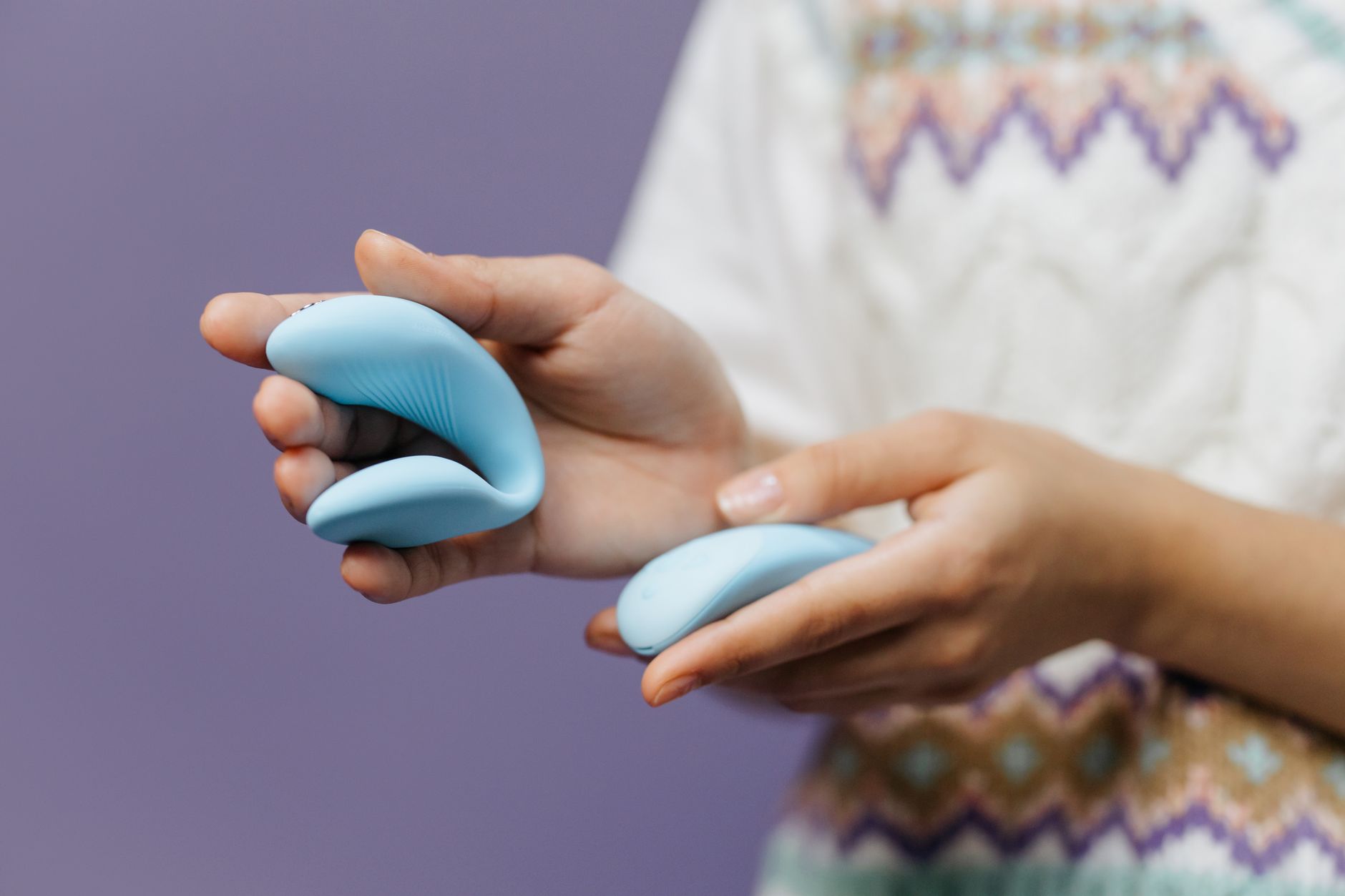
This is where it gets practical. You've probably noticed that lemon suction vibrators aren't what your partner might have expected. They're not aggressive. They're not phallic. They feel less like an invasion and more like an extension of touch.
For nervous partners, this matters. A lot.
With a lemon clitoral vibrator, you stay in complete control. It's external only. There's no penetration involved unless you choose it separately. You can start at the lightest suction setting (usually pattern 1 or 2 on devices like the Lem) and work up at your own pace. Your partner can be involved, or they can be present while you explore solo. You get to decide.
The suction mechanism itself is less intimidating for a lot of people than traditional vibration patterns. It feels more like indirect pressure, less like a buzzing invasion. When you're already nervous, this gentleness actually matters.
Setting boundaries that stick
Before you touch anything, decide what "yes" and "no" actually look like for you.
Yes might look like: "I'm willing to try this with my partner present, fully clothed at first, starting at the lowest setting." Or: "I want to use this solo first, then maybe introduce it later." Or: "I want to try it on a specific day when I feel emotionally ready, not randomly."
No might look like: "I'm not ready to try this in a hotel or anywhere that isn't our home." Or: "I don't want to be surprised by this. I need to know it's coming." Or: "I'm not comfortable with my partner controlling it; I need to hold it myself."
Boundaries aren't walls. They're the conditions under which you can relax enough to actually enjoy something. Name them. Write them down if it helps. Your partner doesn't get to negotiate them. They either respect them or they don't. How they respond to this tells you everything about whether they actually care about your pleasure or just their own.
The first time
Honestly, the first time might be anticlimactic. Literally.
You might use a lemon vibrator and feel... nothing. Or awkward. Or hyperaware of your body and your partner's presence. This is completely normal. Arousal doesn't work on a schedule, and adding newness often adds friction (not the good kind).
Protect yourself from the pressure of "making it work." You're not failing if pleasure doesn't happen immediately. You're gathering information. You're learning what your body likes and what your nervous system needs in order to relax.
Start low and slow. Literally. Lowest setting. Maybe just holding it near, not on. Some people need a long warm-up before any sensation feels good. Some need total focus. Some need their partner to touch them elsewhere while the toy works. There's no standard.
If it doesn't work the first time, that's data. Not failure.
How your partner should show up
Here's what helps. Your partner should:
Check in without performance pressure. "Does this feel good?" Not: "Do you like it?" The second one puts pressure on you to be enthusiastic. The first one invites honest feedback.
Stay present without directing. They can be touching you, holding you, talking to you. But unless you've explicitly asked them to control the toy, they're supporting your experience, not steering it.
Accept a "stop" without negotiation. "This isn't working for me" means stop. Not "let's try one more minute." Not "what if we adjust the angle." Just stop. You get to change your mind.
Normalize this for future conversations. If the first time feels weird or didn't work, your partner should be able to say: "That was interesting. Want to try again sometime?" Not: "Are you sure you don't want to keep going?" Pressure kills desire faster than almost anything else.
When shame shows up (and it probably will)
You might feel embarrassed. You might feel like you're doing something wrong. You might feel exposed or worried you're being judged.
This usually isn't about the toy. It's old. It lives in your nervous system from messages you received about your body, your sexuality, your right to pleasure.
When it shows up, name it. "I feel shame right now." Say it out loud to your partner if you can. Don't try to power through it. Shame doesn't respond to willpower. It responds to gentleness and time.
You might need to pause and come back. You might need your partner to remind you that your pleasure matters to them. You might need to use a lemon vibrator alone first, in your own space, where the only person watching is you.
All of this is okay. There's no finish line here.
Trust rebuilds through small yeses
What I've seen work is this: couples who start very small and let desire build actually end up exploring more, not less. Because each small yes creates a track record. "We did this. I was nervous. Nothing bad happened. I felt something good." That builds trust.
The nervous partner stops being nervous because they've learned their partner respects their boundaries. The partner stops pushing because they're getting genuine participation instead of compliance.
A lemon clitoral vibrator becomes less about proving something and more about shared discovery. It's a tool for exploring together. Not a test. Not a fix. Not proof of anything.
Your pleasure matters. Your comfort matters more than trying something new. And a partner who understands that difference is someone worth building this with.
FAQ
How do I know if my partner's request is coming from a good place?
A good place usually involves curiosity about your pleasure, not disappointment with it. They're interested in trying something with you, not asking you to do something for them. When you express nervousness, do they listen and adjust, or do they dismiss your concerns? That's the real tell.
Can I use a lemon vibrator without my partner knowing?
Yes, absolutely. You have the right to explore your own body on your own timeline. But if your partner has expressed interest in exploring together, using one solo first is actually a great way to build comfort before partnered use. You learn what feels good to you, which makes the conversation easier later.
What if I try it and hate it?
Then you've learned something. You're allowed to try something once and decide it's not for you. That's valid data. Tell your partner: "I gave it a shot and it's not my thing." If they respect that, you're fine. If they push back or make you feel bad, that's a relationship problem that's bigger than the toy.
What if my partner gets upset that I'm nervous?
That's a sign they care more about getting what they want than about your comfort. You don't have to move forward with someone who responds to your vulnerability with frustration. Pleasure should never feel coercive.
Can a lemon suction toy actually help if the relationship feels distant?
A toy can create a moment of connection, but it won't fix resentment or disconnection. If your relationship is struggling, that needs to be addressed first. A lemon vibrator is a bonus once the foundation is solid, not a bridge across a gap.
Should I be worried that wanting a toy means something is wrong with me?
Not at all. Curiosity about pleasure is healthy. The question isn't whether you should want to explore. It's whether you want to explore with this partner, at this pace, in this way. Those are the only questions that matter.
You get to set the pace
Your nervousness isn't an obstacle to overcome. It's information. It's telling you something about your comfort level, your trust, your readiness. Listen to it.
If you decide to explore lemon vibrators or external stimulation with your partner, start small. Start slow. Check in often. Remember that your body's "no" is as important as your "yes." And if your partner can't respect that, no lemon vibrator in the world will fix what's actually broken.
Your pleasure deserves a partner who honors your boundaries. Not eventually. Now.
Resources
For couples navigating toy introduction and communication, consider reading "Come As You Are" by Emily Nagoski for insight into responsive desire and arousal, or exploring the Gottman Institute's resources on intimate communication. If shame or past trauma is affecting your comfort, a sex-positive therapist trained in trauma-informed care can help you work through those patterns.
The conversation doesn't have to be perfect. It just has to be honest.